Tuesday, August 27, 2013

Savannah's Yellow Fever & The Colonial Cemetery

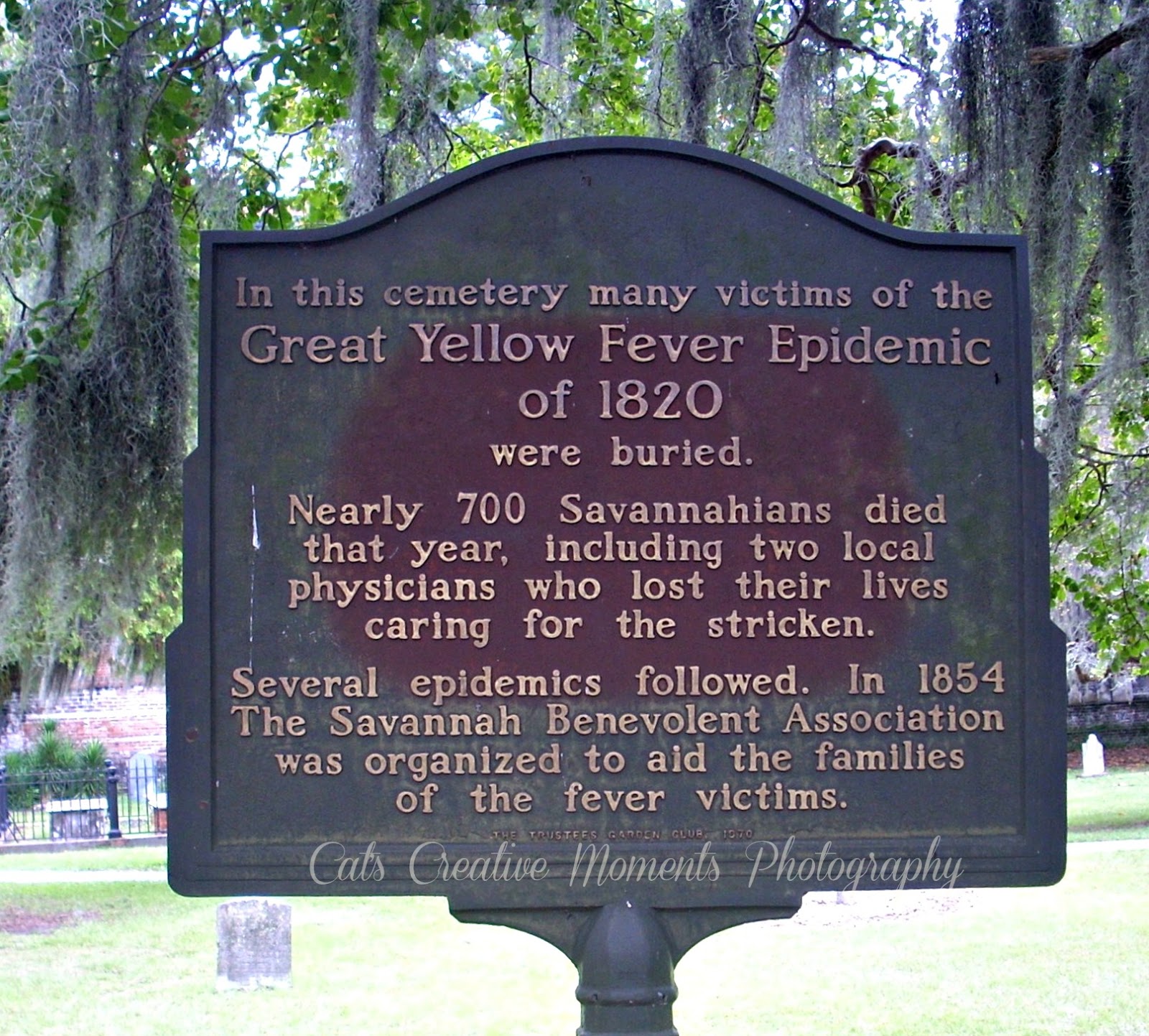
As promised , part two of the historic Colonial Cemetery in Savannah, Georgia .There is a section that has over 700 graves of the Yellow Fever outbreak of 1820. As I walked thru this section looking at tombstones mounted on  the brick wall, thinking of all the people that suffered from black vomit and high fevers,  the hysteria that the town must have felt during this period. It caused merchants to shut down their businesses, and people left the city to avoid catching it. What a scary time it must have been.


To the east of Forsyth Park is the Candler Hospital, many ghost tour companies still tell the stories about the death and dying which took place there. During one of the last Yellow Fever outbreaks in Savannah, as the story is told, there were a great number of people who died in the Candler Hospital from Yellow Fever. So many in fact, that tunnels were dug and secret burials were made throughout the entire area.  One of the secret burial grounds was a tunnel that ran underneath Forsyth Park. This tunnel didn’t have an exit. It was simply a place to put the bodies of the dead without bringing them to the surface. Founded in 1808, Savannah’s Old Candler Hospital has served as a Union hospital and an insane asylum, and thousands of patients, including those afflicted with Yellow Fever, died on the premises. A morgue tunnel once existed under the property, and some speculate the passageway was also the site of clandestine medical experiments. Though the building hasn’t been open to the public in over two decades, passerby report seeing lights and shadows in front of the windows. While on one of the many tours I was on, I was told that a mass grave was dug and bodies dumped under what is now Forsyth Park. Now whether it is true or not , I do not know.


windows where ghosts are supposed to be seen

beautiful iron work on fence next to hospital

Morgue Tunnel


The fountain at the park


There are many things in Savannah worth seeing , so if you get the chance to go, you won't be disappointed. so until next time I leave you with this:


Those we love don't go away, they walk beside us every day, unseen, unheard, but always near, still loved, still missed and very dear. - Anonymous


Sunday, August 11, 2013

Duelists, Ghosts & Revoluntary Soliders

While in Savannah, Georgia I explored  a cemetery full of interesting history, haunting's, and give night time tours, as well. The Colonial Cemetery has 10,000 graves , including a revoluntary war hero, a Declaration of Independence signer, duelists , a consort and sightings of ghosts!  Because this is such an interesting cemetery, I will post in two parts.  I will started with some back ground info on the cemetery, it's first burial was in 1750, and it's last was 1850.  The Entrance:


Perhaps the most famous grave here would be Button Gwinnett, who was one of the signers of the Declaration of Independence . Mr. Gwinnett meet his end after a duel with Lachlan McIntosh, after an argument about who was right regarding an invasion into Florida. 


Major General Nathanael Greene.of the Continental Army during the American Revolutionary War. He was given a plantation named Mulberry Grove, for giving so much to the war, including his own money. He died here of a sunstroke in 1786. The cotton gin  created by Eli Whitney, was made here. He was interned here in the Graham tomb originally then moved to Jackson Square along with his son., in 1902. 


Jackson Square


James Wilde was the brother of the well-known American poet, Richard Henry Wilde. The cemetery commemorative plaque in honor of James Wilde contains a stanza from his brother's most famous poem whose completion was interrupted by the death of James in the duel.


This is the most interesting debated video shot here of a ghost:

You decide what you see. I make no claims to this , neither the person taking the video or saying it is true. 
Until my next post  I leave you with this :


Those we love don't go away, they walk beside us every day, unseen, unheard, but always near, still loved, still missed and very dear. - Anonymous


Monday, August 5, 2013

Slave Cemetery At Mount Vernon

Located not far from Washington's Tomb on the grounds of Mount Vernon , are the burial grounds of the over 50 - 75 slaves that worked and lived there ( 1760-1860). Unfortunately records of slave cemeteries are far and few between . So because of this the headstones and rocks used to mark the graves over the years have either sunk into the ground with the shifting of land, or broken and removed. The few records that are their recorded  was George's valet William " Billy" Lee ( 1828) , his brother Frank Lee ( 1821). West Ford, who was a freed slave but still worked for the Washington family.  A marker was installed by The Mt. Vernon Ladies Association .


                                              Entrance:


                                             Marker:


Close up:


Sign:


Left side of grounds: 


Right side of grounds:


My only regret is that records were not better kept during this time.
 There is a house that has more history of the slaves of Mt. Vernon.
Well worth the trip! 


I leave you with this:

Those we love don't go away, they walk beside us every day, unseen, unheard, but always near, still loved, still missed and very dear. - Anonymous


Thursday, July 25, 2013

Washington's Family Tomb

On Thanksgiving Day , I had the privilege of touring Mt. Vernon, the home of George & Martha Washington. He loved this place so much he wanted to be buried here. The family tomb is on the property. The original tomb was in need of repairs and in a spot that was improperly situated , according to George. He left instructions for a new one to be built, in his will.  This family vault is a two marble sarcophagi containing Washington and the Consort of Washington ( in this case meaning wife* more about this word in other posts). This was completed in 1931, and their bodies along with other family members were moved to the new vault. . George died on December 14, 1799 from acute laryngitis, in his bedroom . Martha died May 22, 1802 from a severe fever ( 105.3) also in her bedroom .


Mt Vernon


The Old Vault


Sign on Path


Inside vault : Martha is on the left & George on the right


Inside with doors shut


Close up of George's


Martha's


''Within this Enclosure Rest the remains of Gen. George Washington"
On Top of Vault


Surrounding the Family Vault is other members of the family
                                                 

Old 1800 photo of New Vault


It was a serene moment viewing the tombs of the bodies of the first President of the Untied States, and his wife , and very interesting to see how they lived their lives together. The era in which they lived was such a different one from now. If you ever get the chance to tour Mt. Vernon, I highly recommend it you will not be disappointed.  Later that evening I dined at a restaurant, whose ( historic) building was located on part of Washington's original  farm, and ate Thanksgiving dinner. To say it was remarkable ( not only the food) and a great privilege to do so , one I will always remember.                                                             


  I leave you with this :

Those we love don't go away, they walk beside us every day, unseen, unheard, but always near, still loved, still missed and very dear. - Anonymous

Tuesday, July 16, 2013

Fascination with Cememteries

This is going to be a prelude to my photos to try and explain how I came to be fascinated with graveyards, tombstones,  and statues in cemeteries. I have a love of history and travel quite a lot, going to historical places has always been a love. Trying to see how those before us have lived and imagine what their lives were like. Every where I have been I always try to find the oldest cemetery, and who is that graveyard, whether they be famous, part of history, or just historic. I think it was started when I lived in Austin, Texas, and went to see Sam Bass who was a outlaw buried in the Old Round Rock Cemetery. While there I discovered near the grave site of outlaw Sam Bass., while there I discovered one-half acre of that cemetery was set aside for slave burials. Enclosed by cedar posts and barbed wire, sites are marked head and foot with large limestone rocks. Some  are hand-grooved with names and dates. . The first marked grave of a freed slave is dated 1880. Although there are 40 to 50 known burial sites of freedmen and the burial ground is still in use, no interments of former slaves occurred after the turn of the century. White graves here are dated as early as 1851 . And from that point on I was totally hooked. So now it is a requirement when I go to a new town.

This is Sam Bass
From Wikipedia,
 
And his tombstone:

 
And these:
 
 
 The slave cemetery ,( images from the Historical Commission)  and some of the graves:


      After I left here, I became a volunteer to help clean up , preserve and document these final resting places. It has been a most unique journey. One I hope you travel with me ... until next time I leave you with this :

Those we love don't go away, they walk beside us every day, unseen, unheard, but always near, still loved, still missed and very dear. - Anonymous